Sacred Music and Chants by the Monks of Drepung Loseling Monastery
Photo : https://www.mysticalartsoftibet.org/sacred-music-sacred-chants
The Ancient Art of Sound Healing
Because of my interest in sound healing, especially toning from the voice, in the early 1990s, I attended a performance at the Santa Cruz Civic Auditorium given by the Tibetan monks of the Drepung Loseling Monastery located in Karnataka State, South India. They are part of the Gelugpa or Yellow Hat Sect of Tibetan Buddhism and represent one of Tibet’s largest monasteries, which was re-established in India after many monks escaped Chinese-occupied Tibet in 1959. The original Drepung Monastery was founded near Lhasa, Tibet in 1416. The Drepung community in South India is a “monastery-in-exile,” dedicated to preserving Tibetan traditions, and where over 2,500 monks reside.
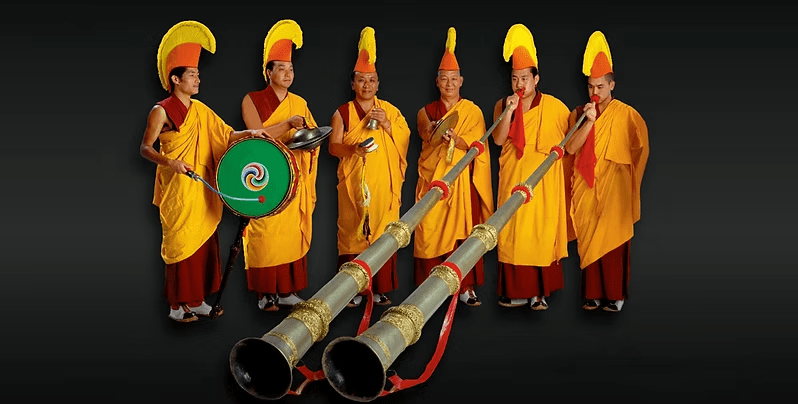
It was an hour’s drive north from my home to Santa Cruz, where the monks would play their traditional Tibetan instruments and perform their sacred chants. When I arrived, I took a seat along with some friends in one of the rows closest to the stage. The monks came out wearing their traditional yellow and maroon robes and wearing their yellow hats—aRtse-zhwa, a tall, crescent-shaped, or fan-like hat with yellow plumes worn during ceremonial events. Their shape represents wisdom and enlightenment, with the high peak symbolizing “middle-way” teaching.
The Loseling Monks are renowned for their multiphonic chanting, known as zokkay, where each monk will simultaneously chant three notes of a chord, creating a complete chord that results in sacred overtones. As they begin their low, guttural chants, they also perform ancient temple music using 10-foot-long dung-chen horns, drums, bells, cymbals, and gyaling trumpets. These sacred sounds are believed to invoke the deities and can often cause the listener to go into deep meditative states and transcend ordinary consciousness.
At first, I found the lowest tones that reached my lower chakras to be painful. The sounds set up a vibration, a resonance in my body, that at first made me want to leave, and not stay for the remainder of the performance. But my inner guidance was to stay and allow the sounds to surround me. Soon, the pain dissolved, and my entire body began to vibrate. As the horns, bells and cymbals were played, the chants became more powerful, and I began to experience something I had only heard of, but never imagined I would feel. As I went into higher and higher states of consciousness, I felt my body begin to disappear! My head was still there, my feet were still touching the floor, but the rest of my body had vanished. I could not see it or feel it any longer. It was an amazing experience, and it left me feeling completely astonished.
I later found out that the monks’ chants are intended to induce a meditative state where one might experience a dissolution of boundaries between oneself and the external world. It is not a physical disappearance, but a profound mental shift where you lose the perception of your body’s limits, often described as a sense of “oneness” or losing oneself. The intense, low-frequency vibrations created by the monks can alter your sensory perception, making your body feel as though it has merged with the sound or has disappeared. This is a recognized effect of this traditional Tibetan meditative practice.
I left that night in a state of awe. For several days after the performance, I began spontaneously toning and chanting in the deep, low tones of the Tibetan monks. I was totally transformed by my experience.
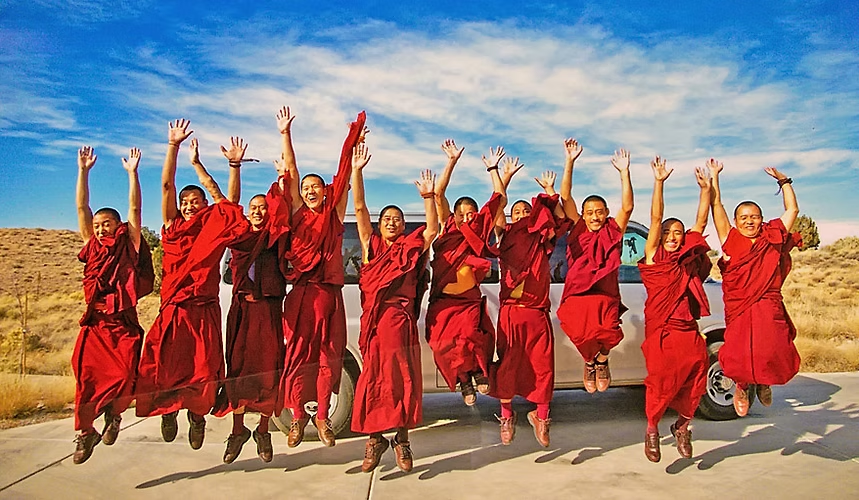
Tibetan Monks of Depung Loseling Monastery Jumping for Joy
Photo: https://www.mysticalartsoftibet.org/about-us
The Mystical Arts of Tibet is a world tour endorsed by His Holiness the Dalai Lama to promote world peace and healing by sharing Tibet’s rich and authentic sacred performing and visual arts with modern audiences. The tours offer a rare opportunity to witness one of the world’s most ancient sacred traditions presented by a group of monk artists for whom these traditions are a way of life.
For more information go to: https://www.mysticalartsoftibet.org/programs